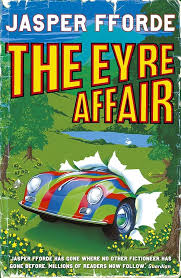
I still remember reading The Eyre Affair by Jasper Fforde back in Year 11 literature. At the time, it felt like a complete revelation. Books had always been a big part of my life, but here was a story that treated literature itself as the characters playground. Thursday Next, literary detective, lives in a world where the lines between reality and fiction blur, and you can quite literally step inside the classics. For a teenager who already spent half her life between the pages of a book, this was freaking brilliant.
The other week I was wandering through a second-hand bookstore when I spotted a copy tucked away on a shelf. No hesitation, I grabbed it to gift to a girlfriend. It felt like rediscovering an old friend. I started my re-read in the shop. And, Fforde’s writing still makes me grin; it is clever without ever being smug, funny without losing the heart of the story. The sheer creativity of it, the idea that Jane Eyre herself could be kidnapped from her own novel, is the sort of thing that never really leaves you.
Part of the fun is how much Fforde packs into the world. The story is set in an alternative 1980’s England where the Crimean War is still dragging on after more than a century, time travel is possible thanks to Thursday’s eccentric uncle, and literature is taken seriously enough that whole police divisions exist to protect it. The villain, brilliantly named Acheron Hades, is deliciously evil, able to manipulate minds and slip into stories themselves. Thursday finds herself in the middle of it all, trying to stop him before he permanently rewrites Jane Eyre.
And that is one of the most delightful touches. Because of Thursday’s intervention, the ending of Jane Eyre changes. Instead of the more restrained close that Brontë originally penned, the characters get the passionate, dramatic finale that most readers know today. Fforde makes it feel as though our reality has always been influenced by Thursday’s actions, which is such a clever way of blending fiction and history together.
I loved studying this book. It never felt like learning in the classroom, it felt like being handed the keys to a secret library where anything could happen. Looking back, I know there was so much I missed as a teenager, little references and sly jokes that went over my head. That makes it even more exciting to pick it up again now.
What I love about The Eyre Affair is how it reminds you that literature is never static. It is alive. It can be reimagined, questioned, pulled apart, and put back together in new ways. Fforde does not just write a detective story, he invites readers to fall back in love with books, to think about what they mean to us and how much we would fight for them if they were under threat. The literary references scattered throughout, from Wordsworth and Shakespeare to half-forgotten Victorian poets, feel like private jokes between book lovers.
I am thrilled to have found that copy again, and even more excited to be sharing it with a truly lovely friend. Some books are more than good reads, they are doorways. The Eyre Affair was one of those for me, and I know it will be again. In fact, it’s been the re-read of the weekend, and I love stepping back into Thursday Next’s strange, layered and brilliant world with a cuppa, with the new Spring sunlight coming in.
 Books, Boots and Bakeries
Leave a comment